Route days Sep 22, 2026 · 5 min read
A route that ends near home
The shortest loop is the wrong goal for a grooming van. Plan the day backwards from your own driveway and you get home with the tank drained before dinner.
Walt Brannigan Co-founder, engineering
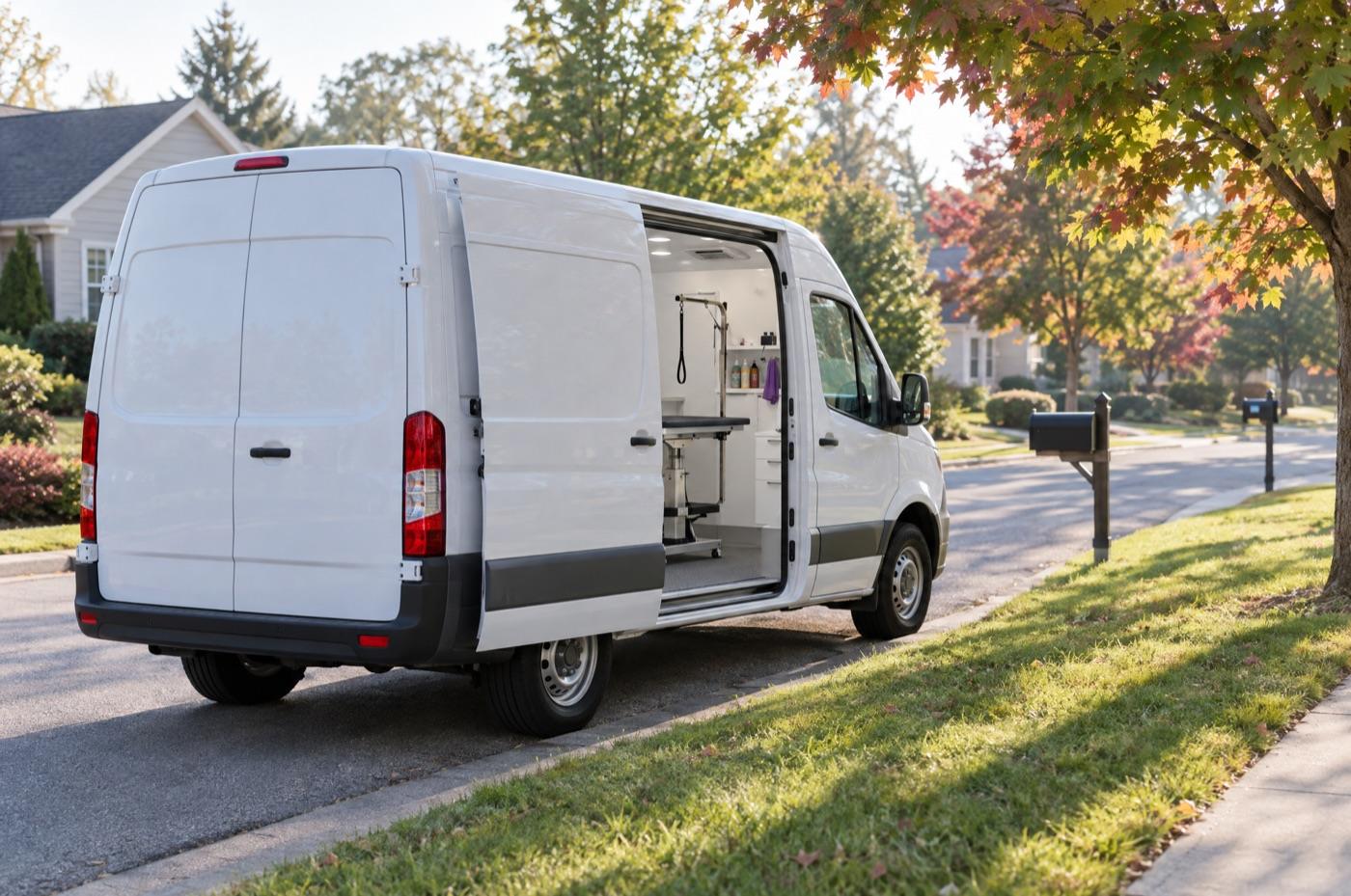
Most route advice is about the shortest total distance. That is the wrong number for a grooming van. A parcel truck does not care where it finishes, because the driver clocks out at a depot. You finish with a wet floor, a tank to drain and forty minutes of cleanup, and you would like to do that in your own driveway before dinner, not across town at 5:10 PM with the sun in your eyes.
So the first rule we give every new groomer is this: plan the day backwards from your own front door.
Start far, finish close
Put your farthest stop first. You drive the long leg once, in the morning, when traffic is light and you have not lifted a single doodle yet. Every stop after that walks you back toward home. If a dog runs long, and one always does, the overrun comes out of a short last drive instead of a long one.
The loop most people draw by instinct does the opposite. They take the nearest client at 8:30 AM because it feels efficient, and by mid-afternoon they are 19 miles out with two grooms left.
Give each neighborhood a day
The single change that saves the most driving is not a clever order. It is refusing to cross town twice in one day. Pick an area for each weekday and hold it:
- Offer new clients the day their neighborhood already has, not the day they asked for first.
- Keep one flexible half-day a week for the households that truly cannot do their area’s day.
- When an area fills past seven stops, split it by a real boundary: a river, a highway, a school zone that jams at 3 PM.
Groomers who do this for a month usually find their driving drops by about a third. Kindred Co. in Pittsburgh cut 31% of their miles this way, mostly by stopping three vans from crossing the same bridge.
Respect the windows you cannot move
Some stops are pinned. The senior poodle who has to be done before the midday heat. The owner who works nights and sleeps until noon. Mark those first, then let everything else arrange itself around them. A route that is ten minutes longer and keeps Mrs. Farrow’s 10:30 AM is a better route than the perfect one that makes you call her.
The best route is the one you never have to explain to a client.
Leave one hole on purpose
Book six stops on a seven-stop day, at least until your waitlist is real. The hole absorbs the matted surprise, the gate code that changed, the dog who needs twenty minutes of convincing. On the days nothing goes wrong, a waitlisted bath near your fourth stop fills it by 9 AM.
What this looks like on a Tuesday
Here is a real shape, from a one-van groomer in Meridian, Idaho. First stop 8:30 AM, 22 minutes from home. Seven stops, all inside the same two square miles, no leg longer than 14 minutes. Total driving: 1 hour 52 minutes across 38 miles. Last dog done at 4:05 PM, eleven minutes from the driveway.
The same seven dogs, booked in the order the calls came in, came to 3 hours 10 minutes of driving. Same work. Seventy-eight fewer minutes behind the wheel.
Bramble builds the day this way on its own: it pins the windows, orders the rest by drive time, and points the loop at your home address. But the rules work on paper too. Far first, one area a day, pinned stops before flexible ones, and one hole.
Less planning, more grooming
Start free on one van for 14 days. Send us your client list tonight and it’s imported by morning.